

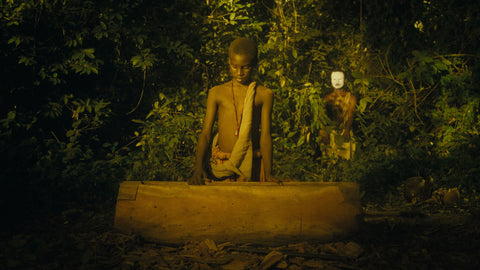
Set amidst the sugarcane fields of the Dominican Republic, Sugar Island follows Makenya, a young Dominican-Haitian woman facing an unwanted pregnancy while navigating a legacy of colonial violence, racial discrimination, and labor exploitation.
Through Makenya’s eyes, the film unfolds a complex story about the intersections of ethnicity, gender, immigration, and class—echoing the lived experiences of many in the Afro-Caribbean diaspora. Gómez Terrero’s unique "kaleidoscopic aesthetic"—which blends documentary realism, spiritual symbolism, and theatricality—elevates this coming-of-age drama into a visually rich, emotionally layered exploration of identity and resistance.
Spain/Dominican Republic, 2024, 91 mins, drama in Haitian and Spanish (with English subtitles), Johanne Gomez Terrero, dir.
“Johanné Gómez Terrero blends tradition and spirituality, the literal and the allegorical, in a beautifully made and deeply touching fiction feature debut. The themes of labour rights, protests against the mechanisation of the sugar industry, and decolonial thought make Sugar Islanda syncretic, politically engaged work that avoids all traces of didacticism. On the contrary, the film’s gorgeous look, thanks to lensing by Alván Prado, alludes to the many layers of reality and beyond"~ Savina Petkova, Cineuropa
Shimu, 23, works in a clothing factory in Dhaka, Bangladesh. Faced with difficult conditions at work, she decides to start a union with her co-workers.
Despite threats from the management and disapproval of her husband, Shimu is determined to go on. Together the women must fight and find a way.
Directed by Rubaiyat Hossain, Bangladesh/France/Denmark/Portugal , 2019, 95min, social drama, English & Bengali w/English subtitles
* Toronto Intl Film Festival - Contemporary World Cinema * London BFI * Stockholm International Film Festival - Competition Films from the South
Set in a dystopian near future in Rio de Janeiro, a lawyer (Alfred Enoch) sues the Brazilian government for reparation of all descendants of African slaves in the country. The authoritarian government responds by signing an executive order sending all black citizens to Africa as an excuse to repay the debts of slavery.
Directed by Lázaro Ramos, 2020, Brazil, 101min, Drama, Portuguese w/ English subtitles.
"A chilling believability creeps into this dystopian debut from actor-turned-director Lázaro Ramos that’s hard to shake off." ~ Cath Clarke, Guardian
"[Executive Order] is Bacurau on a global scale, Get Out without the humor. It's Armee Guineenne unleashed in movie form, a melancholic prophecy of a coming war and a sendoff to those brave African soldiers who dared to fight for their heartland." ~ Asher Luberto, L.A. Weekly
"The directing is excellent, the cast is giving it their all, and the themes are relevant and need to be discussed." ~ Bobby LePire, Film Threat
"Politically and culturally driven it may be, Executive Order still ultimately aims for entertainment and education in equal measure." ~ Peter Gray, The AU Review
The award-winning drama Kuessipan by Myriam Verreault was adapted from the acclaimed novel Kuessipanand co-written with the novel’s First Nation Canadian author Naomi Fontaine. Kuessipan means "your turn" in the Innu language, a title chosen to mark the notion that it is the Innu people's turn to tell their story.
“The Innu voice is ever present, which is so important as it offers a glimpse into their lives without a Colonial perspective. It's a feature that, while seemingly an obvious advantage, is hardly ever utilized for similar films. It means that audiences can enter the world in a respectful manner - which isn't to say the film shies away from the issues, but it does mean that those issues are approached in a confident and dignified way” writes Joel Kalkopf in his review for Switch.
The story follows two girls who grow up as best friends in a Quebec Innu community. While Mikuan has a loving family, Shaniss is picking up the pieces of her shattered childhood. As children, they promised each other to be lifelong friends. But as they mature, their lives take different paths, and their personal ambitions diverge leading them to a cultural and identity clash that tests their bond.
Directed by Myriam Verreault, Canada, 2019, 117min, Drama, Montagnais, French, English w/English subtitles
"Kuessipan is quiet and mesmerizing and tragic and full of hope. It is a triumph, and a privilege to spend time with." ~ Globe and Mail
"Myriam Verreault excels at crafting a film told through an Indigenous lens that discusses universal themes of friendship, identity, love, and heartbreak." ~ Exclaim!
"Kuessipan is a beautiful, un-sensationalized look at young womanhood, friendship and community." ~ NOW Toronto
"Heartbreakingly exploring Indigenous identity and the bonds that root us to a community, Kuessipan is a bold ode to young womanhood." ~ MUBI
The 1960s were a time of change everywhere, and that includes Bamako, the capital city of Mali, a nation only recently independent from French colonial rule.
DANCING THE TWIST IN BAMAKO is a romance fraught with the drama of political change, infused with the musical energy of that decade. Samba, a young, idealistic socialist, works toward creating a more just nation by day and dances with girlfriend Lara to the Beach Boys, Otis Redding, and the Supremes by night.
The film’s sensibility is inspired by the vibrant images, patterns, and compositions of famed Malian photographer, Malick Sidibé. Lara’s orange silk dress and Samba’s dazzling white suit, shot against the striped backdrop of their dance club and the black and white checked dance floor they cut up — all suggest that change is coming rapidly, that life is for living.
by Robert Guédiguian, France / Canada / Senegal, 2021, 129min, Romantic Drama, French with English subtitles.
"Inspired by the photographs of Malick Sidibé, Dancing the Twist in Bamako (the screenplay of which was written by Robert Guédiguian and Gilles Taurand) does not claim to moralise or substitute for an African perspective. The film relies on the universality of love stories that defy (at the risk of their lives) traditions and ideologies, to weave a story nourished by simplicity, enthusiasm, and even the touching naivety of youth, against the backdrop of a utopia of class struggle confronted by "realpolitik." A dive into the past, punctuated by a multitude of hits from the early 60s whose fragrance of effervescent happiness is tinged with nostalgia and tragedy, like a challenge to time and the dictates of the mind." ~Fabien Lemercier, Cineuropa
After fighting censorship for two years in Brazil, MARIGHELLA became #1 at the Box Office in Brazil.
Marighellais a new Brazilian action drama set in 1969 based on the life of Afro-Brazilian politician and guerrilla fighter Carlos Marighella. Facing a violent military dictatorship and with little support from a timid opposition, writer-turned-politician Carlos Marighella organizes a resistance movement. Alongside revolutionaries 30 years younger than him and willing to fight, the revolutionary leader opts for action. The film is adapted from the biography Marighella - O Guerrilheiro que Incendiou o Mundo, by Mario Magalhaes. Brazilian musical artist, songwriter, and actor Seu Jorge plays Carlos Marighella.
Directed by Wagner Moura, 2019, Brazil, 155min, historical action drama, Portuguese w/ English subtitles
* Berlinale 2019 | Official Selection - Out of Competition * INTERNATIONAL INDEPENDENT CRITICS PRIZE (Premio Giuseppe Becce) * ONE OF SCREEN CRITICS' TOP FILMS FROM BERLIN 2019
"Angry and brutally necessary for the Brazil of today,Marighellais put together coolly and confidently by the green [Wagner] Moura." ~ One Room With A View
"Marighella works fine as an exciting and highly assured debut, with a terrific ensemble cast at its heart." ~ Hollywood Reporter
BRAZIL / 1997 / PORTUGUESE WITH ENGLISH SUBTITLES / 38 MIN
SYNOPSIS
On March 13, 1992, Vicente Francisco do Espirito Santo, a Black Brazilian who worked in a government-owned electricity company, was fired from his job. It did not take long for him to realize that his dismissal was directly linked to his skin color. Encouraged by his union and a strong Black empowerment movement, he began a judicial process which he won, and as a result was reinstated in his former position. This informative documentary about an unknown victory illustrates how the courts of Brazil did recognize the company's prejudice and racism in a country where such realities are usually dismissed as atypical.
Angelica, after a long absence from Puerto Rico, returns home when her father, Wilfredo, suffers a stroke. This unexpected return and her father's illness force Angelica to re-evaluate her relationship with her mother and family members who don't accept her because of her skin color. She must face herself and discovers that she does not know who she is. After her father's death, Angelica must decide whether to return to the comfort of her previous life, dissatisfied, but secure, or set on an adventurous path to rediscover herself as an independent, modern, strong, black, and Puerto Rican woman.
Directed by Marisol Gómez-Mouakad, Puerto Rico, 2016, 100min, Drama, English & Spanish w/English subtitles
"Purposely challenging the Eurocentric beauty standards that blatantly plague Latin America on and off screen, Puerto Rican director Marisol Gómez-Mouakad sets out to tell the story of an empowered Afro-Latina fighting colorism at home in her debut feature Angélica." ~ Remezcla
“People talk about racism and sexism in the U.S.,” Gómez-Mouakad explains. “They may not do much, but in talking about it they are at least addressing the problem. In Puerto Rico — and across the Caribbean and Latin America — there is a lot of denial. If you do talk about the issues, you are accused of being over sensitive. But words have power and words can hurt.” ~ director Marisol Gómez-Mouakad
"In addition to the theme of racism, the film touches upon the implications of machismo in a patriarchal society from the perspective of women." ~ Repeating Islands
"Another glorious, glorious portrait on race and the roles women play—by pressure, by tradition, by choice. " ~ Guilie Castillo Oriard
BRAZIL / 1984 / EPIC DRAMA / BRAZILIAN PORTUGUESE WITH ENGLISH SUBTITLES / 114 MIN
SYNOPSIS
This historical saga is a stirring fusion of folklore, political impact and dynamic story-telling, realized in vibrant tropical colors and set to the pulsing beat of Gilberto Gil's musical score. After the slave revolt of 1641, groups of enslaved black Brazilians escaped to mountainous jungle strongholds where they formed self-governing communities. This film is the chronicle of the most famous of these communities which flourished for several decades under the reign of the legendary chieftain Ganga Zumba.
DIRECTOR AND CAST
Director: Carlos Diegues
Starring: Antônio Pompêo, Tony Tornado, Zeze Motta, Zózimo Bulbul
DIRECTED BY MEHDI BARSAOUI TUNISIA/ 2019/ DRAMA/ ARABIC WITH ENGLISH SUBTITLES/ 96 MIN
SYNOPSIS
An intense family drama starring French-Tunisian actor Sami Bouajila, winner of the Orizzonti Award for Best Actor, Venice Film Festival 2019. 11 year old Aziz needs a liver transplant after being seriously injured during a terrorist ambush while on holiday in 2011. At the hospital, a family secret will be revealed.
A drama that expertly captures complex human emotions within their socio-cultural, historical and political context. ~ Hollywood Reporter
Not many debuting directors are able to bring subtlety and depth to a heart-rending subject, which is just one reason why Mehdi M. Barsaoui's superb "A Son" deserves significant attention. ~ Variety
It's a film reminiscent of the work of Iranian master Asghar Farhadi [A Separation, The Salesman], full of twists and turns as it puts its characters in increasingly tragic situations. ~ Cineuropa
AWARDS
César Awards, France (2021) Best Actor: Sami Bouajila
Victoria Film Festival, Canada (2020) Best Feature: Mehdi Barsaoui
Malmö Arab Film Festival (2020) Best Actress: Najla Ben Abdallah
Kosmorama, Trondheim Internasjonale Film Festival (2020) New Director's Award: Mehdi Barsaoui
Venice Film Festival (2019) Best Actor: Sami Bouajila
Cairo International Film Festival(2019) Arab Cinema's Horizons Award: Mehdi Barsaoui Salah Abu Seif Prize: Mehdi Barsaoui UNFPA Award: Mehdi Barsaoui
Hainan International Film Festival (2019) Young Talent Award Winner: Best Feature Film
Demba is an African who has fled an oppressive regime in his own country and is seeking asylum in Paris. One night he encounters Lucien, a policeman from the Caribbean, who speaks to him in the voice of the dominant class. But in his country Demba is a professor of History and Geography while Lucien left school early to help his mother, a cleaning lady.
“YAFA Le Pardon” explores the social and economic dynamics at work in their relationship as they seek to understand each other, aided by Welcome, a Baule Komian who does not hesitate to officiate as the parties meet on the Quai de l’Oise, in the centre of Paris.
Directed by Christian Lara, France, 2019, 85 Minutes, drama, French with English subtitles
"In my young adult years in France, I could see that there was tension between the Caribbean community and the African community, but I didn’t know why. The hidden historical facts, the great Black characters erased or transformed, the identity and culture construction... This is the thread of the ongoing dialogue between Demba (Sidiki Bakaba) and Lucien (Luc Saint-Eloy). The migrant and the policeman. Africa and the West Indies." ~ Karukerament Read full review HERE
ABOUT DIRECTOR CHRISTIAN LARA Christian Lara is a Guadeloupean/French film director, writer, cinematographer and producer. Having shot more than twenty feature films in the Caribbean, France, Canada and Africa, he is regarded by many as "the Father of French Antilles cinema".
Official Selection Trinidad and Tobago Film Festival 2022 African Diaspora International Film Festival, NYC 2022
"Ludi," directed by Edson Jean, is a compelling exploration of the Haitian immigrant experience set in the vibrant community of Little Haiti in Miami. The film follows the resilient protagonist, Ludi, portrayed by the talented Shein Mompremier, as she grapples with the challenges of forging a new life in America. In the pursuit of the elusive American dream, Ludi confronts the harsh realities of the immigrant experience.
Edson Jean's directorial finesse captures the nuances of cultural identity, economic struggle, and the indomitable spirit that propels individuals to persevere against adversity. The film not only sheds light on the immigrant narrative but also serves as a poignant reflection on the strength and resilience of those who dare to seek a better life in a new land. "Ludi" stands as a significant contribution to the cinematic exploration of diasporic experiences within the Afro-Caribbean context.
Directed by Edson Jean, USA, 2021, 81 Minutes, drama, English and Haitian Creole with English subtitles
"Jean's "Ludi" is the type of low-stakes drama that's easy to root for, and even more wonderful to see" - Robert Daniels, The Playlist
"This is one of the best films of the year so far, and that comes as a result of the hard work and dedication from everyone involved." - Kyle Bain, Film Threat
"An examination of the difficulties inherent in that so-called American Dream, with a magnetic lead performance from Shein Mompremier. Ludi is a charming, tragic, painful, and beautiful film to behold." -Aaron Peterson, Hollywood Outsider
WINNER! * FIPRESCI Award, International Film Festival Mannheim-Heidelberg 2022, Germany * VISIONARY AWARD , Cinequest 2022
The Sleeping Negro, by Skinner Myers is a provocative and introspective film that delves into the complexities of race, identity, and societal expectations in contemporary America. The story centers around a young African American man grappling with the pressures and contradictions of living in a predominantly white society.
As the protagonist navigates his day-to-day life, he confronts instances of racism, microaggressions, and the internal conflicts that arise from trying to assimilate while preserving his cultural identity. The film boldly addresses themes of self-awareness, the psychological impact of systemic racism, and the struggle to find authenticity in a world that often demands conformity.
Skinner Myers’ approach to storytelling in The Sleeping Negro is both intimate and confrontational, compelling viewers to reflect on the deeper societal issues that affect African Americans. The film is particularly significant for its unflinching portrayal of the emotional and mental turmoil experienced by its main character. It is an essential resource for students and scholars in Africana Studies and Film Studies, providing a poignant exploration of racial dynamics and personal identity in the context of African American life.
Following on the footstep of the LA Rebellion filmmakers, Skinner Myers tells a very personal and intimate Black story in a radically non-traditional cinematic style as a means to express freely his feelings as a Black man in America.
By Skinner Myers, USA, 2021, 72min, Drama, English
"A superb character study of a black man, how he sees himself and how he was treated by society, it is surreal yet real and terrifying." ~ Ulkar Alakbarova, moviemovesme.com
"Remaining asleep to Myers as an African-American is a sin, but so is to be completely awake to the point where love for the self is all but embraced. In this impassioned, vigorous, lucid cinematic journey, the bleak, bruised-yet-fighting spirit of one Kendrick Lamar’s and every other prominent African artist strikes like lightning, and resonates like thunder. Like the greats, Myers, is a voice in his lane to place one’s focus on; his artistry effortlessly commanding, a feat implying many more to be accomplished in a budding career in American independent filmmaking." ~ LOUIE BAHAROM, cinephiliaph.wordpress.com
Official Selection ACID Cannes Film Festival 2023!
Nome is a historical drama directed by Sana Na N'Hada and written by Virgílio Almeida and Olivier Marboeuf. The story takes place in Guinea-Bissau in 1969, during the war of independence between the Portuguese colonial army and the guerrillas of the African Party for the Independence of Guinea.
The protagonist, Nome, leaves his village and joins the ranks of the guerrillas. After years of struggle, he returns to his village as a hero. However, the initial joy soon gives way to bitterness and cynicism.
By Sana Na N'Hada, Guinea-Bissau/France/Portugal/Angola, 2023, 117min, Drama, Portuguese w/ English subtitles
"Nome is a film over 50 years in the making. In the late 60s, revolutionary Bissau-Guinean Marxist leader Amílcar Cabral sent filmmakers Sana na N’Hada, Flora Gomes, Josefina Lopes Crato and José Bolama to Cuba. To help change international public opinion against the Portuguese colonial regime, they returned to the country to document the struggle. This archive footage forms the basis for the fiction Nome, N’hada following its eponymous character as he joins the resistance movement.
Perhaps Cabral, had he lived to see this movie (assassinated in 1973), would be disappointed, as Na N’hada, returning to one of his first filmmaking projects, complicates a simple resister narrative into a more complex tale of post-colonial legacy and the true cost of war. Things get particularly messy when the occupation is over, colonial occupation giving way to corruption and petty gangsterism on the streets of Bissau, issues that have plagued the country until this day.
Independence, it seems, is just the start. " ~ ACID Cannes 2023
Fatem, sixth month pregnant, leaves her village perched in the mountains, to fill a frame with empty glasses for the elder of her village, the only person who can decipher the letters sent by members of the villagers’ families who have gone to work in the cities. She moves from station to station to arrive in town in the middle of a protest. This will turn her trip into a peaceful revolution that she is hardly aware of.
Directed by Sanaa Akroud, Morocco 2020, 86min, drama, Arabic w/English subtitles
"A beautifully observed meditation on faith, perseverance and integrity, Moroccan director Sanae Akroud’s sophomore feature is an immersive and heart-breaking unique female saga. " ~ The Brazilian
"This film, which carries beautiful qualities of image and lighting, speaks of poverty, of the feminine condition and of a happiness so simple that one can hardly grasp its meaning nowadays. ~ La Presse
"Fatem is played by Sanaa Akroud, also the film's director. Akroud was in the acclaimed 2011 Egyptian film "Scheherazade, Tell Me a Story". In "Myopia" she is brilliant as our unsettlingly passive villager, whether inquiring about a letter from an absent husband or when wandering innocently through the city in search of an eyeglass shop." ~ Barbara Nimri Aziz
"She will be questioned by the police, defended by an association, interviewed by a journalist… She is accused of having endangered her baby, she is asked some of the most intrusive questions, but each person applies their own way of thinking - myopia of a society incapable of perceiving its difference. Agressive police officers falsely accused, activists urging her to press charges, sensationalist journalist who transforms news, even a listening minister… none understand that she only wants to fix the glasses." ~ Olivier Barlet
"It is in listening to these women that Sanaa Akroud wrote this script which she both interprets and directs. Apart from the interviews, she does it with few words. Wolfango Alfi's sequence shots respond to this desire to account for the time taken by everyday acts. They contribute to the open-mindedness called for by this film without a clear message, if not to invite people to understand that an equivocation is not a limit but a complexity." ~ Olivier Barlet
"This story is sure to resonate with many American viewers learning about the depth of racial disparities and the flaws in U.S. democracy where agents of ‘liberal’ society and opposition parties once again reach out to Black and Brown Americans and immigrants with shallow promises of equality and reform." ~ Barbara Nimri Aziz
The Last Meal: Where the flavors of Haiti bridge a lifetime of silence.
After twenty years of silence, a dying Reynold asks his estranged daughter, Vanessa, to share his final meals. As she prepares the traditional Haitian dishes of his youth, the familiar flavors unlock painful, buried memories of his life and suffering under the Duvalier dictatorship.
Set against this backdrop of the Duvalier era, The Last Mealis a poignant tale of reconciliation, exploring the power of food, cultural memory, and confronting the past to heal fractured family bonds within the Haitian experience. A beautifully crafted film about legacy, healing, and the stories we carry in our bodies and kitchens.
Canada, 2024, 111 mins, Drama in English, Maryse Legagneur, dir.
“In this film, humanity, dignity, and beauty stand in opposition to the worst atrocities.” — Manon Dumais, La Presse
Awards and recognition • Grand Prix — Quebec City Film Festival • Marimbas Award (Top Jury Prize) — Miami Film Festival • Best Narrative Feature — Montreal International Black Film Festival • Best First Feature — Kingston Canadian Film Festival
“The Wall Street Boy / Kipkemboi" tells the story of a young math genius from rural Kenya who uses his understanding of patterns in nature to develop a successful stock market algorithm. His remarkable success from a makeshift setup in his village draws attention from international financiers and local authorities, forcing him and his girlfriend Chepchirchir to flee.
This fictional film explores themes of innovation, resourcefulness, and the clash between tradition and modernity. It serves as a valuable educational resource, prompting discussions on financial literacy, ethics in global finance, and the socio-economic dynamics of contemporary Africa.
Kenya/Canada, 2024, 90 mins, drama in English, Charles Uwagbai, dir.
“The Wall Street Boy, Kipkemboihas a strong socially conscious subtext as the village youth becomes a political prisoner. If redistribution of wealth to the least of these among us is a socialist principle, suffice it to say that “Kipkemboi” cleverly achieves this – but through exploiting the capitalist system. The film also is very positive about the role of women as strong equals. Not only is Kipkemboi’s mother supportive, but Chipchirchir is no mere cheerleader. She does more than inspire Kipkemboi; she drives their getaway vehicle and this village lass has dreams of her own, aspiring to become an attorney. Watching the romance of the appealing leads blossom is also beguiling."~ Ed Rampell, The Progressive Populist
MEXICO / 2018 / SPANISH WITH ENGLISH SUBTITLES / 104 MIN
SYNOPSIS
Critically acclaimed drama Black Mexicans / La Negrada by Jorge Pérez has recently been acquired by Artmattan Productions!
Black Mexicans / La Negrada is the first Mexican feature film about the Afro-Mexican community, filmed entirely with people from different towns around the Costa Chica in Oaxaca.
Among the black people in the Costa Chica in Oaxaca, it is socially accepted that a man lives with more than one woman. Juana and Magdalena share Neri’s love, they both know that this situation is hurting them. Juana will have to die in order to show Magdalena a new path for her life.
In Mexico, the afro communities represents only 1% of the total population. They have never been recognized as an ethnic group, nation or culture, suffering discrimination as an outcast group. LA NEGRADA is the first Mexican fiction movie filmed entirely in one of those black communities, with local people, no professional actors. An effort to give them voice and make them visible.
MOTO TAXI, Narcisse Wandji's first feature film, explores questions and concerns related to the daily life of three Cameroonians,two men and a woman, who manage to make a living working as motorcycle taxis.
Sani, Marie and Franck are three young moto-taxi drivers with unique destinies and stories. Sani has to face Charles, his employer and also father of Samedi, his girlfriend, who is pregnant with his child. Marie, raped five years ago, tries to find Tom, her rapist. And Franck, on his side, must do everything to get rid of the lifeless body of an 8 month old child.
In Moto Taxi, Narcisse Wandji refers both visually and through the dialogues in his film to some important auteurs in African Cinema. Quartier Mozart by Jean-Pierre Bekolo is mentioned casually in a conversation while a Moto Taxi driver explains that the corn on his motorcycle was inspired by Djibril Diop Mambety’s Touki Bouki.
“These references reassure the cinephiles looking for cinematic innovation. The question of cultural identity remains at the heart of the auteur’s work while he/she strives to give a universal feel to his/her creation. “ Pierre Patrick Touko.
Directed by Narcisse Wandji, Cameroon, 2021, 90 mins, drama, French (with English subtitles)
As Far as I Can Walk is a 2021 internationally co-produced drama directed by Serbian Oscar-nominated director (for his 2003 short film '(A)Torsion') Stefan Arsenijevic that follows a couple who left Ghana with a dream of a better life in Europe and now live as refugees in Belgrade.
22-year-old Siisi, nicknamed Strahinja, is doing everything to integrate in Serbia. He volunteers for the Red Cross in the camp where he lives, looks for work, plays on the local football team... His biggest challenge, however, is to win back the woman he loves. When she disappears one day, Strahinja sets out to find her.
As Far as I Can Walk is a re-imagining of a traditional medieval epic in which contemporary African migrants take the place of Serbian national heroes. Urgent and timeless at the same time, the adaptation raises questions about identity, tradition, race and love.
It premiered at the 55th Karlovy Vary International Film Festival in 2021 where it won five prizes including the main Grand Prix – Crystal Globe and the Best Actor honor awarded to Ibrahim Koma for his starring performance in the film.
By Strahinja Banović / Serbia / France / Luxembourg / Bulgaria / Lithuania / 2021 / 92 min / English and Serbian with English Sub.
“It’s a surprising and exhilarating blend of contemporary refugee story, love triangle and medieval Serbian poem.” ~ Alisa Simon, Variety
“In his masterfully directed picture Stefan Arsenijević delivers a crystal clear, humanistic account of the need to find one’s place in the world; this is also a tale of love, the most profound testimony of which might also be the most painful.” ~ Lenka Tyrpáková, Karlovy Vary FF
“Arsenijević's film is vividly crafted and performed. The predominantly English-language film should gather interest [ ] on the strength of its topicality and emotional accessibility.” ~ Guy Lodge, Variety
“The refugees are presented as broken and poor, but dignified, and as opposed to many other similarly themed films, we get real, flesh-and-blood characters in Strahinja and Ababuo, with well-defined personalities, pasts and hopes for the future. And therein lies the film's greatest strength: both actors are positively magnetic on the screen, but especially Koma, whose drive and extraordinary charisma often collide with Mensah-Offei's pride and headstrong ambition.” ~ Vladan Petkovic, Cineuropa
“One of Arsenijevic’s avowed goals with As Far as I Can Walk was to portray refugees as distinct individuals with inner lives, dreams and aspirations, not just blank statistics. In this he is admirably successful.” ~ Stephen Dalton, Verdict
ABOUT THE MAKING OF THE FILM
“Arsenijević’s hometown Belgrade marks an important point on the Balkan migrant route. A few years ago, he could see thousands of new refugees arriving every day. He says, “Having my own experience of war and poverty in the 90s, I could easily identify. I started talking with migrants, hearing their experiences. There was this moving story of epic proportions happening right in front of me. It was just important to find the right angle to tell it.” As the migrant crisis grew, many locals promulgated paranoid fears that migrants would take over European culture by imposing their own. “National identity and national heritage are touchy subjects in my country,” says Arsenijević. “So, it occurred to me: what if I replace Serbian national heroes with contemporary African migrants? I thought this could provide some interesting perspectives.” ~ Alisa Simon, Variety
BELGIUM / 2024 / FRENCH WITH ENGLISH SUBTITLES / 107 MIN
SYNOPSIS
Brussels teacher Amal encourages students' passion for reading and freedom of expression, despite risks. Her daring approach leaves a mark on pupils and families.
"What makes the film tick, apart from its powerful message of religious intolerance mixed with the freedom required for us to live in the modern world, is Lubna Azabal’s powerful performance as the leading character," ~ E. Nina Roth
"“With ‘Amal,’ my goal was to address the issue of the influence of the Muslim community within our schools and to shed light on the fear it can instil in teachers,” Jawad Rhalib for Variety
"...Azabal delivers a heart-ripping performance as a strong and determined woman slowly collapsing under the unbearable weight of bigotry. Her eyes are trembling and burning with love and desperation in equal measures, her desire to help others entirely palpable," ~ D Movies
FRANCE and MOROCCO / 2018 / FRENCH, ARABIC WITH ENGLISH SUBTITLES / 95 MIN
SYNOPSIS
Growing up in the Moroccan village of Tazzeka, Elias learned the secrets of traditional Moroccan cuisine from his grandmother who raised him. Years later, meeting a top Paris chef and a young woman named Salma inspires him to leave home.
Rediscover a major work of Nigerian film history in its 50th anniversary year.
Filmed in Hausa in 1976 by Nigerian director Adamu Halilu, Shaihu Umar is a landmark of pre-Nollywood Nigerian cinema and an important work for the study of African film, history, literature, Islam, slavery, and cultural memory.
Based on the acclaimed novel by Abubakar Tafawa Balewa, who later became Nigeria’s first prime minister, the film is set in northern Nigeria at the end of the 19th century. Through the life journey of Shaihu Umar, it explores displacement, slavery, Islamic education, family separation, spiritual development, and the search for identity and belonging.
Long considered lost, Shaihu Umar was rediscovered when its camera negative was located in the Nigerian Film Corporation archive in 2016. The film was subsequently digitally restored by Arsenal – Institute for Film and Video Art with the support of the German Embassy in Abuja. The restored version premiered at the Berlinale in February 2018.
In 2026, fifty years after its original release, Shaihu Umar offers students and educators an exceptional opportunity to engage with a rarely seen chapter of Nigerian and African cinema history.
Recommended for courses and collections in: African Studies • Africana Studies • Film & Media Studies • Nigerian History • African History • Hausa Studies • Islamic Studies • African Literature • Slavery Studies • Postcolonial Studies • Film Preservation and Archival Studies
SYNOPSIS
Set in northern Nigeria towards the end of the 19th century, Shaihu Umar begins with a discussion between Islamic students and their renowned teacher, the wise Shaihu Umar.
Asked about his origins, Umar recounts the extraordinary story of his life. Born into a modest family, he is separated from his mother after the death of his father and the banishment of his stepfather. His subsequent journey is marked by displacement, enslavement, hardship, and profound personal transformation.
Eventually adopted by his Arab master, Abdulkarim, Umar attends Koranic school and later becomes an imam. Following a powerful dream, he resolves to search for the mother from whom he was separated as a child.
Through Umar’s journey, the film examines slavery within Africa, Islamic education and spirituality, family and belonging, and the social world of 19th-century northern Nigeria.
ABOUT THE RESTORATION
Nigerian filmmaker and film critic Didi Cheeka has worked for years to reassess and preserve Nigeria’s cinematic heritage. He initiated the archive project Reclaiming History, Unveiling Memory, dedicated to restoring, digitizing, and curating rediscovered Nigerian films.
Shaihu Umar, one of the most significant works uncovered through this effort, had long been considered lost. The rediscovery of its camera negative in 2016 made the reconstruction of the film possible.
Arsenal – Institute for Film and Video Art restored the film with the support of the German Embassy in Abuja. The digitally restored version premiered at the Berlinale in February 2018.
FILM DETAILS
SHAIHU UMAR Directed by Adamu Halilu Epic Drama | Nigeria | 1976 | 142 min. Hausa with English subtitles
Based on the novel Shaihu Umar by Abubakar Tafawa Balewa.
CAST
Umaru Ladan — Shaihu Umar Mairiga Aliyu — Fatima Husaini Mohammed — Umar, age 3 Umaru Dembo — Makau Assad Yasin — Abdulkarim Harira Kachia — Kaka
CREW
Director Adamu Halilu
Screenplay Adamu Halilu, based on the novel of the same title by Abubakar Tafawa Balewa
Directors of Photography Yusuf Mohammed, Zakari Yusufu
Editing Edwin Apim
Sound Baba Gana
Production Design Assad Yasin
Producers Umaru Ladan, Umaru Dembo
Produced by Federal Ministry of Information (Federal Film Unit Kaduna)
ABOUT ADAMU HALILU
Adamu Halilu was born in Adamawa State, Nigeria, in 1936. He studied screenwriting and editing in London. In addition to directing feature films, Halilu wrote screenplays and participated in the production of nearly 70 documentary films. He died in 2001.
Selected Filmography
1963 — Mama Learns a Lesson, 48 min. 1971 — Child Bride, 70 min. 1976 — Shaihu Umar 1978 — Kanta of Kebbi 1981 — Moment of Truth, 90 min. 1982 — Zainab
Bio- and filmography based on Berlinale 2018 materials.
CUBA / 1979 / SPANISH WITH ENGLISH SUBTITLES / 95 MIN
SYNOPSIS
Maluala takes us into a palenque, a settlement of escaped slaves hidden somewhere in Cuba's eastern mountains, where discord is sown between black "kings" by clever subversives working for the Spanish government.
"Sergio Giral is the best known of the Black Cuban directors and his previous films were historical observations of the period of slavery in Cuba, the gradual rise of rebellion against colonial traditions, and the ultimate freedom that resulted. Maluala is the most striking addition to this genre. The action takes place during the last century in the region of Maluala. Gallo, the black chieftain, together with his cohort, Coba, present a petition for land and liberty to the colonial government. Governor Escudero offers liberty if the rebellious villages will be dismantled and their men offer themselves in surrender. He promises that they will be freed shortly thereafter. Three chieftains agree, but Gallo and Coba refuse... Giral has mounted Maluala with colorful ritual and acting. Samuel Claxton, as Gallo, is highly stylized in the heroic tradition. It is an absorbing adventure film wrought from historical events which appear violent, but Giral constantly implants into every image the necessity for unity among people in order to combat man's seemingly casual desire to subjugate mankind, in the struggle for power and undefined ambition." ~ /San Francisco Film Festival, 1980/
"The historically lucid intrigues of Maluala (1979), where the Afrocentric leadership of fugitive palenque communities is pitted against each other COINTELPRO-style by Spanish colonists, is one of those Cuban films that were forged in a righteous, red-hot ferment but still found the courage and wit to ask questions about the society around them." ~Gary Dauphin, The Village Voice
SENEGAL AND FRANCE / 1998 / FRENCH WITH ENGLISH SUBTITLES OR DUBBED WITH ENGLISH / 70 MIN
RESTORED HD COPY AVAILABLE
SYNOPSIS
This animated film exquisitely recounts the tale of tiny Kirikou born in an African village in which Karaba the Sorceress has placed a terrible curse. Kirikou sets out on a quest to free his village of the curse and find out the secret of why Karaba is so wicked.
Lisa Nesselson of Variety (11/1/99) notes: "KIRIKOU AND THE SORCERESS employs snappy visuals to tell a catchy story for all ages. A blend of African folktales "Kirikou" has both humor and flair." KIRIKOU depicts a precocious newborn infant who battles ignorance, and so-called evil, with endearing perseverance. This film speaks to the child within us all who yearns to express and defend the best in others and ourselves. KIRIKOU's stunning visuals are accented by a traditional music soundtrack by African music giant Youssou N'Dour of Senegal.
"A blend of African folktalesKirikouhas both humor and flair.Kirikou and the Sorceressemploys snappy visuals to tell a catchy story for all ages." -Lisa Nesselson of Variety
“Kids will love Kirikou and the Sorceress, an offbeat carton feature about an alarmingly brainy tot. The lesson taught by Kirikou, that an evildoer actually is someone in pain, is a good one for kids to learn early” - The Record
“In its 16-year history, the Chicago International Children’s Film Festival’s two juries – one comprising children, the other adults – had never given their top prized to the same film, until last year, when both juries honored Kirikou and the Sorceress, a beautifully animated first feature by French filmmaker Michel Ocelot about an African boy’s battle with an evil witch for the soul of his people. Filled with lessons about morality, bravery, selflessness and compassion, Kirikou and the Sorceress is top-shelf family entertainment.” - Chicago Tribune.
“Kirikou and the Sorceress is magic from a clear sky. Dazzlingly painted images limn forth this folklore based animated feature by French-born, Guinea-raised Michel Ocelot. A newborn toddler whose simple powers are speed, mischief and ingenuity outwits an evil sorceress who comes on like a bead-bedecked Gloria Swanson. In the best tradition of National Geographic ethnography, everyone is naked, beads apart, and the scenery is gorgeous. Kirikou and the Sorceress is funny, charming, wise, beautiful, and exciting…” Arts section - Financial Times
"Should appeal to younger children and to adults who can appreciate its quiet pleasures." -- Eric Harrison, Houston Chronicle